
Marks That Survive Washing, Polishing And Daily Use
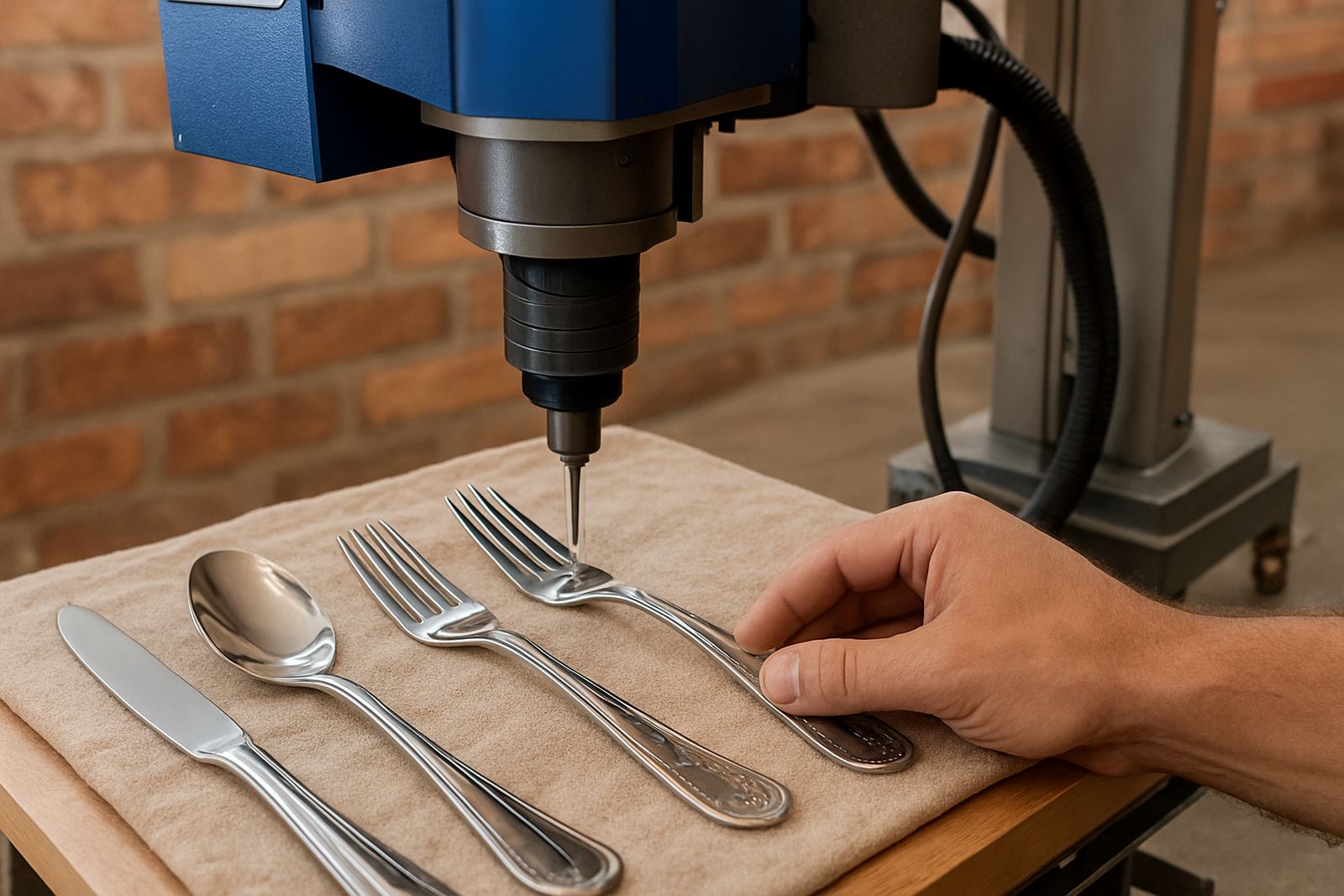
For cutlery makers, the mark has to look neat on day one and still look neat after many washes, handling and packing. Fibre laser marking is suited to stainless steel, coated metals and many plated parts because it produces a fine, permanent mark with very little surface damage. That matters when you are sending product to hotels, restaurants, retailers or export buyers who check finish quality closely.
We work with workshops in Germiston, Johannesburg, Kempton Park, Boksburg and further afield where production is often split between polishing, finishing and packing. On cutlery, the main targets are logos on handles, batch codes on hidden surfaces, part numbers on specialty items and decorative pattern lines on premium ranges. A clean mark reduces returns and gives your brand a more professional look, especially on gift sets and tableware sold as a complete range.
Typical Machine Set For A Cutlery Shop
A practical setup for cutlery work usually includes a fibre marking machine with a stable marking head, a small worktable, a rotary fixture for round handles or utensils with curved surfaces, and software for logos, text and serial numbers. For higher output, many clients also add a fume extraction unit because fine marking on coated or polished parts can create a smell and light smoke in a small room.
- Fibre laser marking machine with a suitable lens for fine detail
- Jigs or fixtures to hold knives, forks, spoons and serving tools consistently
- Rotary attachment for handles, ferrules or curved specialty pieces
- Software for artwork, batch numbers and variable data
- Extraction and simple dust control for a cleaner workspace
If you are marking cutlery in batches, repeatability matters more than speed alone. A good fixture saves time because operators do not need to adjust every item by hand. It also helps with alignment on matching sets where the logo must sit in the same place on each knife and fork. In busy workshops, a tidy flow from marking to inspection to packing cuts down on handling mistakes.
Planning The Marking Area In A Tight Workshop
Many cutlery makers work in small rooms with polishing, assembly and packing happening close together. The marking station should be placed away from heavy grinding and wet processes, because metal dust, vibration and moisture can affect finish quality. If your workshop is in a coastal area such as Durban or Gqeberha, humidity control matters too, since wet air can leave marks on polished stock and make packaging less predictable.
Allow space for infeed and outfeed trays, one bench for finished parts, and another for samples and approvals. It helps to keep the operator facing the same direction all day, with clear light for setup and a solid surface that does not move. In some municipal areas, especially where you share premises with other tenants, it is worth checking noise, fumes and electrical load before installation. Fibre marking machines use low power compared with many other metalworking systems, which makes them easier to fit into a small factory or backroom area during load-shedding planning.
Common Mistakes With Knives, Forks And Specialty Utensils
One common mistake is choosing a machine set-up that is too large for the actual part size. Another is marking directly on an uneven or brushed surface without testing first, because the logo can look strong on one sample and faint on another. Some customers also forget that polished cutlery reflects light strongly, so they need good fixture positioning and a proper test run before going into volume production.
- Skipping sample marking on the exact material finish
- Using loose fixtures that let the part move during marking
- Placing the logo too close to a bend, weld or seam
- Choosing artwork with very thin lines that disappear on small handles
- Not planning for rework or rejected pieces in the daily count
Another issue is expecting one setting to suit every utensil in a mixed range. A teaspoon, steak knife and serving tong do not behave the same under the beam. We usually advise customers to set up a few standard recipes and lock them down once the sample has been approved. That saves time and keeps the marking consistent across staff and shifts.
What Cutlery Makers Usually Spend In Rand
Budget depends on throughput, part size and how much automation you need. A basic fibre marking package for a small workshop can start in the lower tens of thousands of Rand, while a better fitted system with fixtures, extraction and software options can move into the mid-range. If you need multiple jigs, rotary tooling, sample approval support and installation at a second site, plan for a higher budget.
As a working guide, many South African cutlery clients look at around R120 000 to R280 000 for a solid production-ready setup, with more complex cells going above that if the line needs custom fixtures or higher marking speed. The real cost also includes training, setup time and preventive maintenance. Spending a little more on the right fixture often saves money later because it lowers scrap and reduces operator error.
For businesses that are growing slowly, it can make sense to start with one marking cell and add tooling as orders increase. That keeps cashflow manageable and still gives you a permanent marking process that suits stainless steel products used in demanding service conditions.
Support For Installations, Training And Ongoing Use
Cutlery production needs practical support, not just machine delivery. Our team handles machine installation, operator training, software setup, focus calibration, fixture design, sample marking and process optimisation across Germiston, Wadeville, Jet Park, Isando, Kempton Park, Boksburg, Alberton and nationwide. If a site needs relocation or breakdown repairs, we also assist with planning and recovery so production can resume quickly.
Wessel Vermaak leads the business from Wadeville, with support from a team that understands workshop constraints and production timing. For cutlery makers, that often means testing a logo on actual stock, checking readability under normal packing light and making sure the mark still looks right after polishing. When the setup is correct, operators can work quickly and the finished product looks consistent from the first piece to the last.
If you are marking knives, forks or speciality metal utensils, the best next step is to send through your sample requirements on the enquiry form and ask for a practical recommendation based on your material, finish and daily volumes. That way you can choose the right machine and avoid paying for features you do not need.