Accurate fibre laser marking for jewellery
Jewellery is unforgiving work. A ring shank may only give you a few millimetres of flat area, a pendant can move on the fixture if it is not held properly, and a bangle often needs marking on a curved face without distorting the artwork or text. For that reason, the machine, the lens choice and the fixture matter just as much as the file you start with.
Most jewellers want crisp initials, serial numbers, hallmarks, logo marks, size indicators or fine decorative engraving on gold, silver, platinum and stainless steel items. A fibre laser gives a tight spot size and controlled beam path, which helps when the job calls for small fonts, delicate linework or a consistent finish across a full batch. It also suits workshops that need repeatable results on the same item day after day.
In a South African workshop, practical issues also count. Load-shedding can interrupt a job halfway through, coastal humidity can affect storage and handling, and municipal inspections may require a neat, safe layout with clear cable management. A proper setup keeps the marking area stable, the laptop or control unit out of the way, and the operator able to work without hunting for power points or moving items around the room.
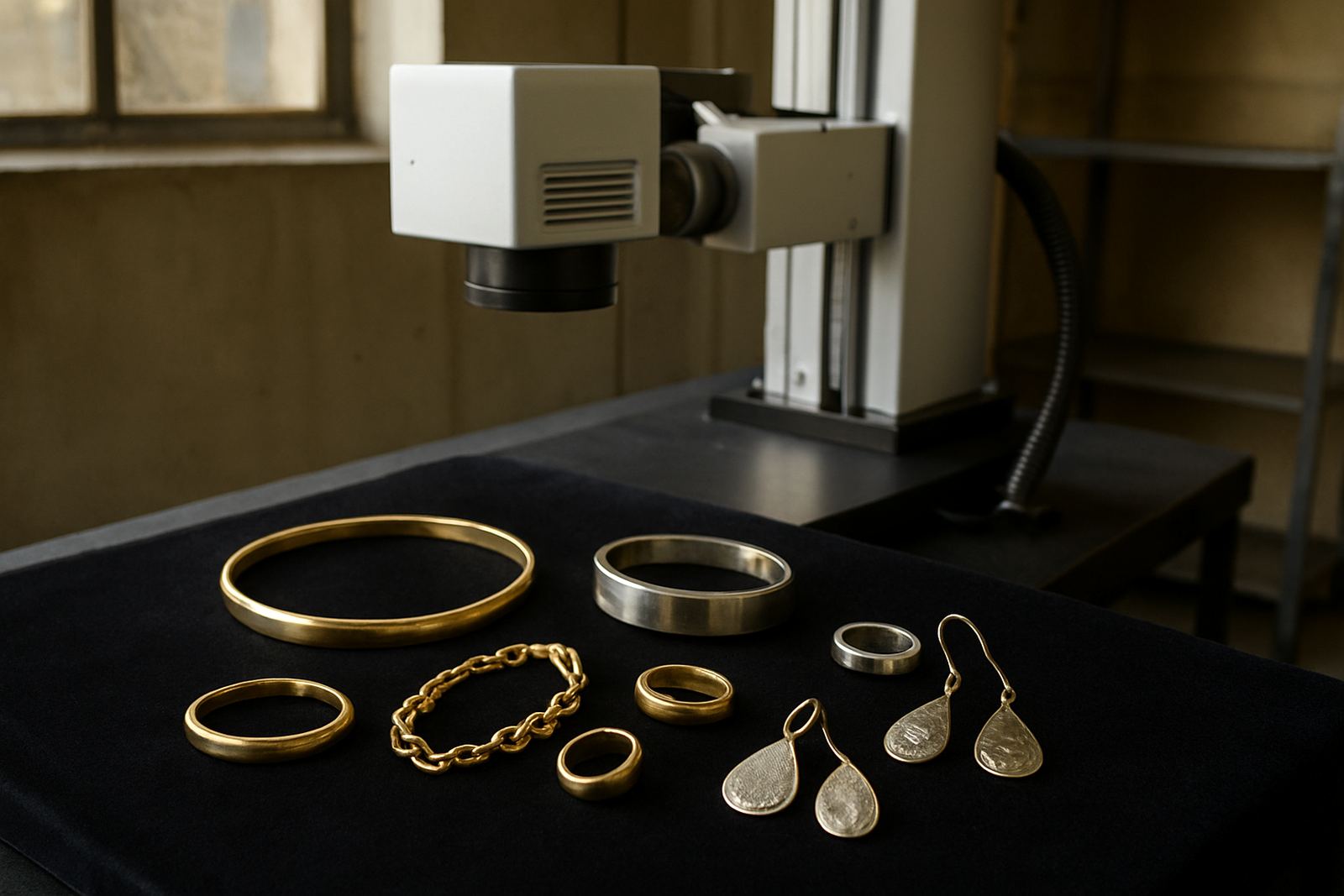
Typical jewellery marking equipment for small and medium workshops
For jewellery work, the usual setup is not complicated, but each part must suit the product size and the type of mark. The aim is to keep the surface secure and the focal point correct, especially on curved or polished pieces.
- Fibre laser marking unit with suitable power for precious metals and stainless steel
- Rotary attachment for rings, bangles and cylindrical items
- Fine fixture plates, small clamps and soft jaws for delicate pieces
- Focus gauge and adjustment tools for repeatable setup
- Control laptop or marking software station
- Extraction or fume management where polishing compounds or coatings are involved
Some workshops only need a compact unit for sample work, repairs and short runs. Others need a larger machine with a rotary table, deeper working area and more rigid fixture options for production batches. If your work includes both plain text and detailed artwork, it helps to choose a machine that can switch quickly between jobs without a long reset. That saves time and reduce errors when the order book is full.
At Wadeville in Germiston, the team can help with machine installation, software setup, sample marking and fixture design, so the system fits the items you actually mark rather than a generic catalogue spec. That is especially useful when the same shop handles bespoke wedding bands one day and batch-marked charms the next.
Layout and planning advice for a jewellery marking room
A jewellery marking area should be organised around control, lighting and movement. Keep the machine on a solid surface or stand, with enough room for the operator to load tiny items without knocking the work off centre. Good task lighting is important, but avoid glare on polished metals because it makes alignment harder.
Plan the room so the marking station sits close to finishing and inspection, yet away from dust from polishing and casting areas. Many marks fail not because the laser is weak but because the item is dirty, oily or still carrying compound from earlier handling. A clean prep bench, a place for trays and a simple workflow from incoming piece to final check will save a lot of rework.
- Allow enough space for ring holders, trays and a small inspection area
- Keep power protection in place for outages and voltage dips
- Store delicate stock in dry conditions, especially near the coast
- Separate marking from polishing to limit contamination on the lens and fixtures
- Leave room for future rotary accessories if your range grows
If you are setting up in Germiston, Isando, Jet Park or Kempton Park, it also helps to think about access for deliveries and service visits. A tight room can still work, but there should be enough clearance for maintenance and for loading a bangle fixture without forcing the operator into an awkward position.
Common mistakes that cost time and scrap
The most common mistake is trying to mark jewellery with the wrong holding method. A ring set loosely in a generic clamp will shift the moment the laser starts. A pendant on a weak fixture can twist, and a bangle without correct support may show uneven depth around the curve. Another problem is using artwork that looks fine on screen but is too fine for the actual item size. A 3 mm font on a tiny charm can become unreadable after polishing.
Operators also sometimes overcomplicate the first setup. They want every feature turned on at once, then the result becomes hard to repeat. It is usually better to start with a simple test pattern, confirm focus and speed, then move to the final mark. This keeps the process practical for training new staff too.
Other mistakes include ignoring material differences, not checking the effect of previous polishing, and skipping sample marking before batch production. A small change in power or scan speed can make a bright clean mark on silver but a harsh mark on softer items. With precious metals, less is often more.
What a sensible budget looks like in Rand
Budgets vary by output, item size and how much accessory support you need. For a small jeweller doing repairs, engraving and limited custom work, an entry level fibre laser setup with basic fixtures can start around R180 000 to R280 000. This is usually enough for lighter marking duties and sample work, provided the fixture planning is done properly.
A workshop that needs better repeatability, more attachment options and stronger rotary support should budget in the range of R280 000 to R450 000. If you want higher throughput, more detailed fixture options, better focus control and room for a wider product mix, the investment may move beyond R450 000 depending on the accessories, installation needs and the marking size required.
It is worth budgeting for the full working setup, not only the machine. Include training, software setup, a few sample runs, fixture design and preventive maintenance planning. If power backup is needed because your area sees frequent load-shedding, that should be part of the project cost too. A machine that sits idle during outages is not good value, no matter the purchase price.
Support for jewellery businesses across South Africa
Fibre Laser Marking supports jewellery workshops from Wadeville, Germiston and the surrounding East Rand, with installs and training available nationwide. That includes machine installation, operator training, software setup, preventive maintenance, breakdown repairs, spares supply, focus calibration, fixture design, sample marking, process optimisation, site relocation and remote assistance.
For clients who need help getting started, the process is straightforward. The team looks at the item type, expected volumes and available space, then recommends a machine and fixture set that matches the work. If you are in Alberton, Boksburg, Isando or Kempton Park, or further afield in another province, the same practical approach applies. The goal is to mark cleanly, keep waste low and make the setup easy to run every day.
Jewellery marking should be precise, repeatable and tidy. With the right fibre laser and a sensible workflow, a small workshop can produce work that looks finished the first time, without fighting the equipment on every job.