What mining workshops need marked
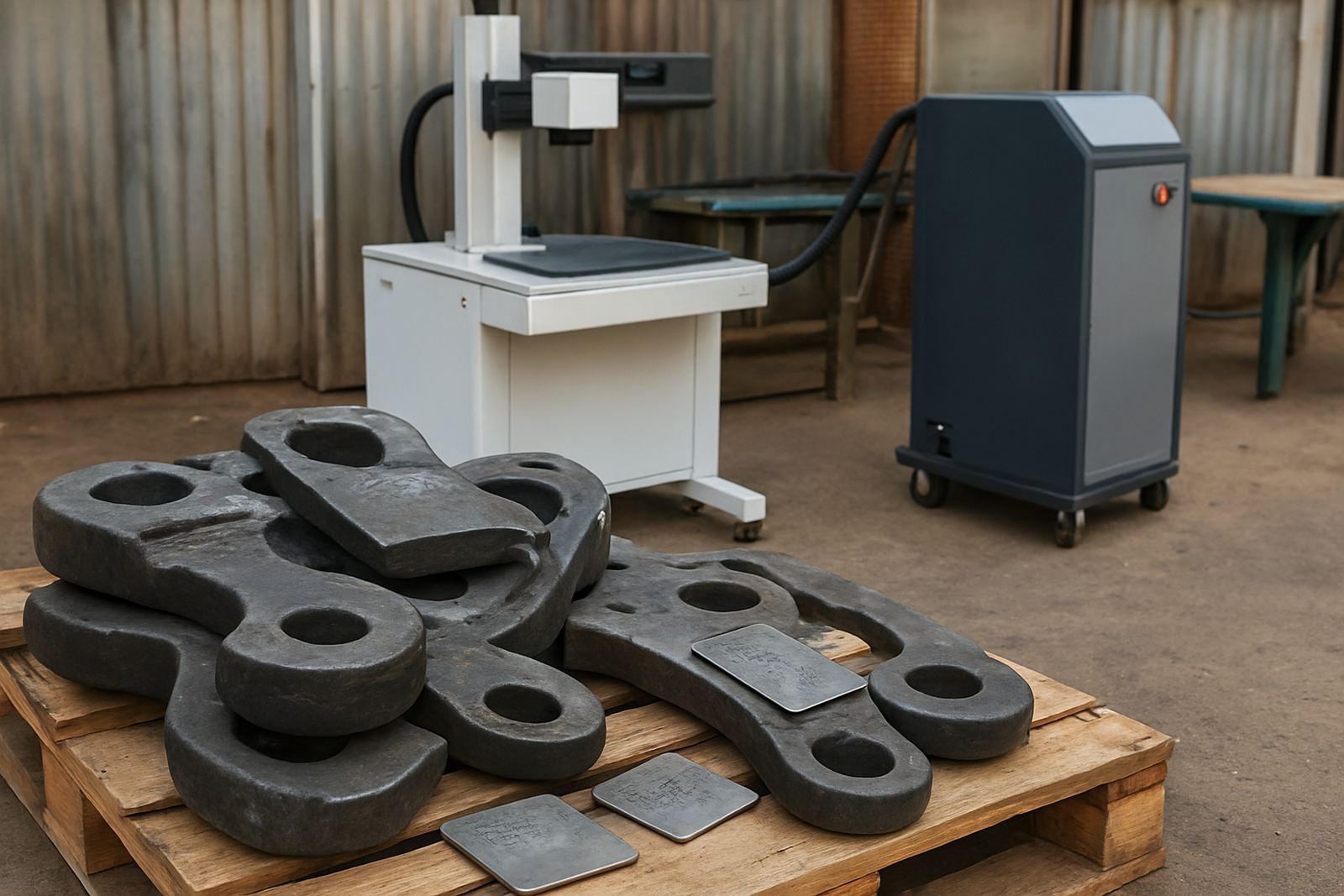
Mining maintenance teams work with parts that get handled, cleaned and moved between site, workshop and supplier yards. On items like steel plates, brackets, shafts, valve bodies, couplings and custom-fabricated spares, the mark must still be visible after abrasive dust, moisture and chemical cleaning. A fibre laser gives sharp marks on metals without inks, stickers or loose tags that peel off when conditions get rough.
For many mines and contractors, the issue is not just putting a number on a part. The mark has to support asset control, rebuild records, inspection tracking and traceability for parts that may move through Welkom, Rustenburg, Secunda, Kathu or Richards Bay. That is where a controlled, repeatable marking process saves time and stops mix-ups in busy stores and repair bays.
Common items marked for mining use include:
- Machined steel components and wear parts
- Tooling, jigs and fixtures used in repair workshops
- Stainless tags and nameplates for plant identification
- Aluminium panels, control boxes and safety plates
- Brass or copper labels for electrical and instrument work
Typical machine setup for mine and workshop use
Most mining customers need a fibre laser system set up for small to medium metal parts, with enough control to mark serial numbers, batch codes, logos, QR codes and safety text. A practical set-up usually includes a laser marking head, control computer, software, a stable worktable and a fixture or vice that holds the part correctly. For repeated jobs, a rotary unit helps with shafts, rings, collars and round components.
In Wadeville and Germiston we often specify systems that suit repair shops, machine shops and central stores. If the site is dealing with production peaks or shift work, we can add sample marking, fixture design and software setup so the operator does not waste time on trial runs. Where the environment is dusty or the power supply is not ideal, planning for clean air, proper earthing and stable power is important. Load-shedding is still a reality, so many customers arrange backup power for the PC and machine controls to avoid losing work mid job.
- Flatbed setup for plates, tags and small housings
- Rotary attachment for shafts, rings and cylindrical parts
- Simple enclosure or guarded area for safer operation
- Extraction or dust control where polishing residue is present
- Barcode or QR software for traceability and stock control
Layout planning before installation
Good planning keeps the marking station productive from day one. The machine should sit where parts can be loaded safely, with enough space for infeed and outfeed tables if the workshop handles larger batches. In many mining facilities, the marking area works best near the toolroom, stores or dispatch point so parts do not move around the site more than necessary. If you are fitting into an existing bay, allow space for operators to stand clear of moving trolleys and still reach clamps, laptops and measuring tools.
Think about the size and weight of the parts before choosing the workstation. Small tags and plates can be handled on a compact bench, but bigger fabricated items may need a wider table and better lifting access. Coastal humidity in places like Durban or Richards Bay can affect storage and corrosion, so marked parts may also need a clear cleaning routine before marking. If the site relocates workshops or sends equipment between branches, site relocation and calibration support help avoid downtime and poor mark quality.
It also helps to decide who will control the file names, numbering sequence and approval process. A tidy file structure sounds simple, but it prevents duplicate part numbers and wrong job runs when a team is under pressure.
Common mistakes that create downtime
Many mining sites run into problems because the marking job is treated like a side task. The most common mistake is trying to mark dirty, oily or heavily scaled parts without cleaning them first. That can reduce contrast and make the mark less clear than expected. Another issue is using a fixture that does not hold the part square, which leads to uneven marking depth and extra rework.
Operators also get caught out by poor file management. If the same serial format is used by different teams without control, records become messy fast. In some cases, customers buy a machine that is too small for the part size or too basic for the number of jobs needed each shift. The result is slow throughput and avoidable strain on the team.
Be careful not to rely on printed labels for parts that see heat, oil, wash bays or rough handling. Labels can lift. A fibre laser mark is better for permanent identification, but it still needs the right power, focus and test settings for the metal being used.
- Marking parts that are still oily, rusty or dusty
- Skipping calibration after moving the machine
- Using weak fixtures for heavy components
- Not planning for backup power during outages
- Leaving numbering control to different people without a process
Budget ranges for mining marking projects
Budget depends on the marking size, automation level and the kind of parts you handle. A smaller fibre laser marking set-up for tags, plates and general workshop work can start in the lower Rand hundreds of thousands, while more advanced systems with rotary work, extra fixtures and higher-duty use can move into a higher bracket. For a mine or engineering contractor, the real cost is not just the machine price. It also includes training, setup, spare parts planning and the time saved on rework.
As a practical guide, many customers budget for three parts: the machine itself, the installation and training, and a maintenance or support allowance. Preventive maintenance matters because mining workshops often run in dusty conditions, and a machine that is kept clean and aligned will give steadier results. If your site has multiple branches or a central repair workshop, remote assistance can reduce travel time for simple setup questions and file checks.
For a more exact figure, the team usually reviews part samples, marking size and workflow first. That keeps the proposal sensible, not over specified.
Support from Wadeville to mine sites nationwide
Fibre Laser Marking is based in Wadeville, Germiston, with installs and training across South Africa. Our team works with mining suppliers, repair shops and fabrication teams that need practical marking solutions for metal parts and plant identification. Support can include machine installation, operator training, software setup, focus calibration, fixture design, sample marking, process optimisation, breakdown repairs and spares supply.
For mining environments, the value is in keeping the marking station reliable and easy to use. The goal is not fancy equipment sitting idle. It is a setup that operators can run confidently on shift, with clear records and consistent results. Whether you are marking small spares in Alberton or setting up a central workshop closer to the mines, the same basic needs apply: clean loading, stable power, correct focus and a controlled numbering system. That approach keeps the work moving and cuts avoidable stoppages.
- Wadeville Support
- Germiston Support
- Jet Park Support
- Isando Support
- Kempton Park Support
- Boksburg Support
- Alberton Support
- Nationwide Installs