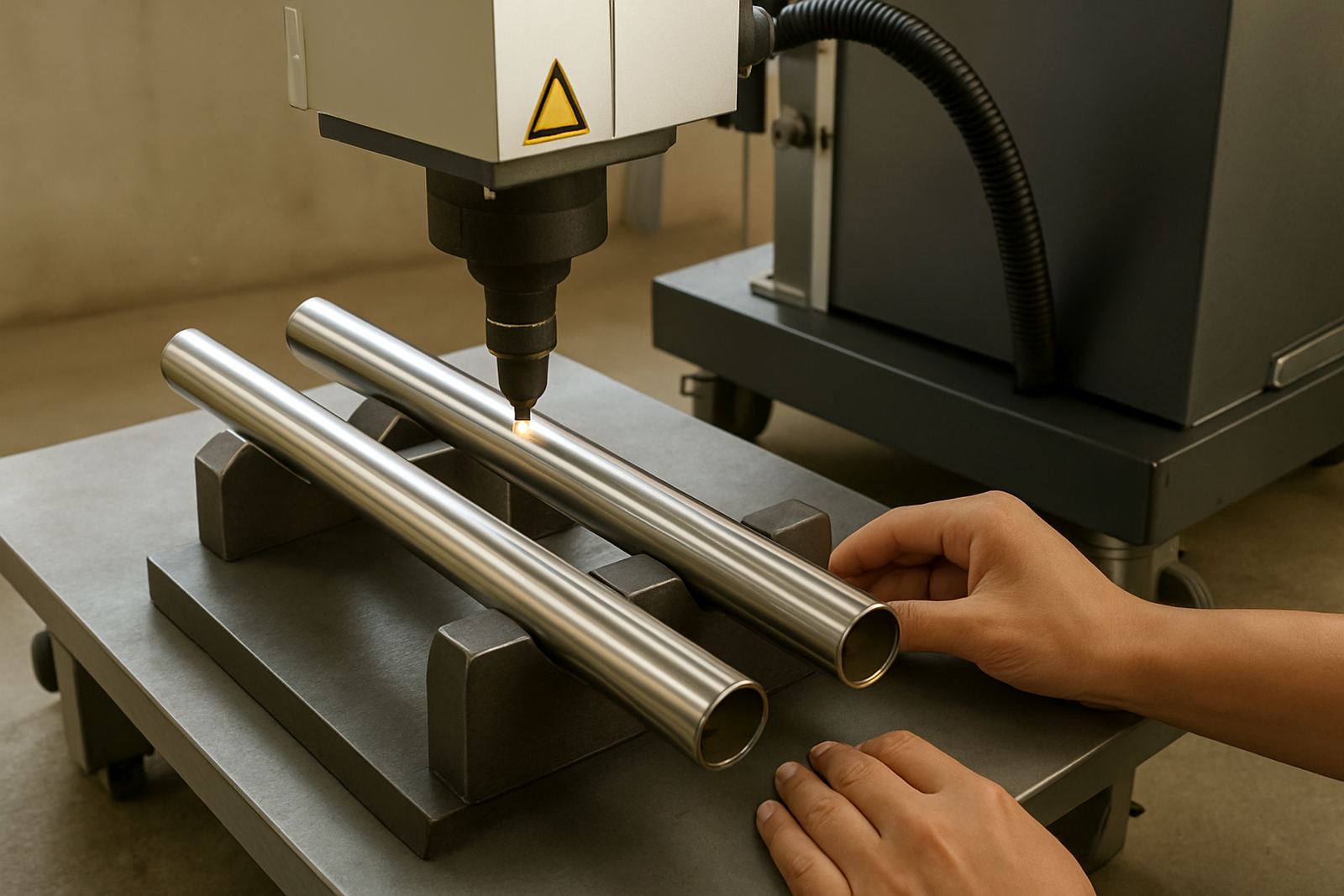
Built For Round Parts That Must Stay Aligned
This Tube Marker is arranged for parts that do not lie flat on a standard marking table. The rotational support keeps the tube or cylinder in the right position while the fibre laser applies a sharp mark around the surface or on a set mark point. That helps when you need consistent orientation for serial numbers, calibration marks, or branding on metal parts that move through a production line.
It is used where marking must stay readable after handling, heat, oil, washing, or outdoor exposure. On mild steel, stainless steel, aluminium, brass, copper, coated metals and jewellery items, the marking remains clear and legible without inks or stickers. For sites in Gauteng, the marking area can be placed in a clean prep bay or near CNC and fabrication equipment, provided dust control and earthling are in order.
Common Sizes And Configuration Options
Tube marking jobs differ a lot, so the machine setup can be matched to the workpiece diameter and the mark length needed. Smaller jewellery and instrument parts need fine control, while pipe and shaft work needs more space and a steady rotary unit. We help specify the correct chucking method, rotary size, lens choice and work height for the part you are marking.
- Rotary attachment options for small diameter tubes and larger cylindrical parts
- Workstation sizes suited to rings, sleeves, shafts, pipe sections and round fittings
- Lens choices for fine detail, shallow marks or wider marking fields
- Manual, semi-assisted or production-oriented loading depending on volume
- Optional fixtures for repeat location on batch work and mixed part sizes
In practical terms, the right setup depends on the outer diameter, wall thickness and how often the part size changes. If your job card includes different tube lengths, we can set out the best clamping method so changeovers stay quick and the part does not slip during marking.
Where The Tube Marker Suits Best
This product suits metal workshops, signage and trophy work, jewellery manufacturers, automotive suppliers, maintenance teams, and fabricators that need traceable marks on round components. It is also useful for small batch work where each piece must be identified before assembly or dispatch. For custom jobs, the machine can handle short runs and repeat runs without needing consumables or solvents.
Because fibre laser systems are dry systems, there is no ink, gas bottle for the marking beam, or curing time to manage. That makes them practical in South African sites where load-shedding, limited floor space and dust are part of daily work. A well planned marking station can sit near packaging, inspection or assembly, as long as the environment is reasonably clean and vibration is controlled.
- Metal parts that must carry part numbers or trace codes
- Jewellery and small round items needing fine detail
- Pipe, tube and shaft marking for fabrication and maintenance
- Workshop jobs that need a clean, permanent mark with no touch-up
Installation, Power And Site Readiness
We handle machine installation, software setup and operator training from Wadeville, Germiston, with installs nationwide. Before delivery, the site should have a suitable table or stand, enough space for the marking head and rotary unit, and a stable electrical supply. Most fibre laser marking machines run from standard single-phase power, but the exact requirement depends on the model and any dust extraction or cooling accessories fitted.
For setup, the main things to check are power quality, earthing, bench height, ventilation and safe access around the marking area. If the site has generator backup or inverter support, it must be sized correctly because voltage dips can interfere with reliable operation. In coastal areas, extra care is needed for humidity and corrosion, so a dry, clean room is better than an open bay.
- Single-phase supply on most workshop models, model dependent
- Stable earthing and protected outlet recommended
- Clean, low vibration mounting surface
- No process gas required for the laser beam
- Space for the rotary unit and workpiece loading
Care, Maintenance And Production Support
Routine care is straightforward, but it matters. Keep the lens and protective glass clean, make sure the rotary parts are free of swarf, and check that the clamps still hold the part true. If a tube is slightly out of round or poorly cut, marking can wander, so prep quality at the cutting stage makes a big difference. A quick inspection before each shift saves rework later, it really does.
Our support covers preventive maintenance, breakdown repairs, focus calibration, sample marking, process optimisation and remote assistance where suitable. For production sites, we can also assist with fixture design so repeat jobs load faster and operator error stays low. If the machine needs to move to another workshop, site relocation can be planned to protect the laser head, rotary unit and control system during transport.
- Clean optics and the marking area regularly
- Check rotary alignment after any heavy move or vibration
- Keep files, parameters and job settings backed up
- Book servicing if marks start to fade, shift or double up
What To Confirm Before You Order
To quote the correct Tube Marker, we need the part material, the outside diameter range, the length of the marking area, the mark depth or contrast needed, and the daily volume. If you are marking a mix of tubes and solid round parts, tell us the biggest and smallest item in the batch. It also helps to know whether the mark must sit in one fixed position or wrap around the circumference.
For better fit-up, send a sample marking photo, a drawing, or even a rough sketch with dimensions. That lets us advise on lens size, rotary capacity, clamping method and software setup before the machine arrives. If your team needs training, we can plan operator handover at the same time as installation so the first production jobs go through without delay.
- Material type and finish
- Diameter range and part length
- Mark area size and position
- Batch size and daily throughput
- Any fixture, barcode or serial number needs
Key facts
| Marking type | Fibre laser engraving and marking for cylindrical and tubular metal parts |
|---|---|
| Part handling | Rotary positioning for stable alignment on round components |
| Materials | Steel, stainless steel, aluminium, brass, copper and coated metals |
| Typical power | Single-phase workshop supply, model dependent |
| Controls | PC-based marking software with repeat job storage |
| Support | Installation, training, maintenance and nationwide field service |