
Retail Jewellery That Needed Clean, Small Detail
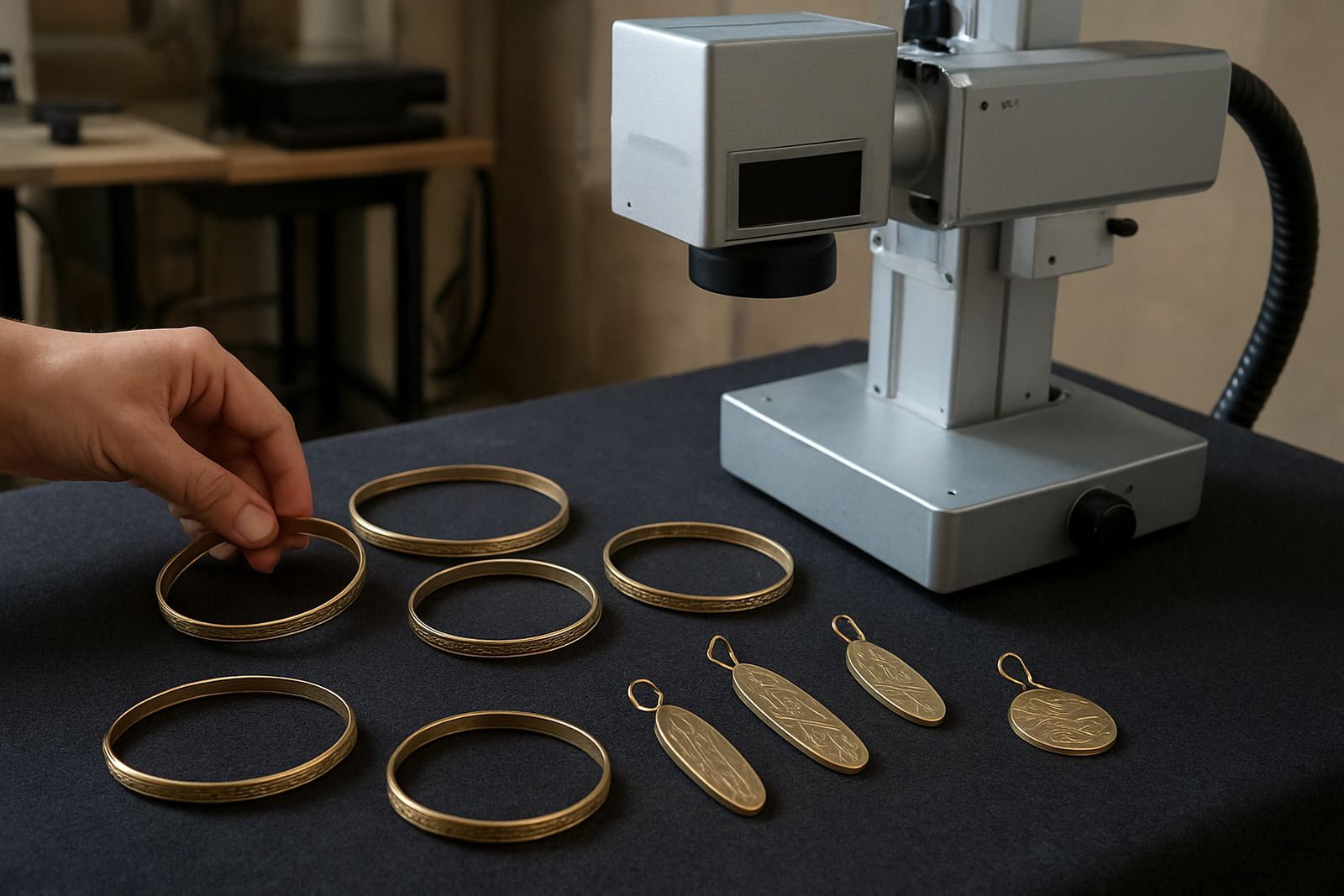
The client was a small-to-medium jewellery producer in Cape Town, supplying retail counters and bespoke orders across the city and surrounding suburbs. Their brief was simple on paper but demanding in practice: produce fine decorative engraving on pendants and slim bangles without distorting the pieces or slowing down dispatch. The finish had to look crisp under shop lighting, stay readable after wear, and suit items that were sold individually as well as in small matched runs.
The biggest challenge was the scale. Pendants were small, with thin edges and polished faces, while the bangles had narrow sections that left little room for error. The client also needed consistency across mixed batches because stock was moved between display trays, gift orders and quick turnaround restocks. That meant the marking process had to be repeatable, fast, and gentle enough for precious metal surfaces, not a trial-and-error approach.
We started with sample marking on provided pieces and test blanks to check contrast, line width and surface reaction. On jewellery work, even a slight change in focal height can show, so the setup had to be measured properly from the start, not adjusted later and hoped for the best.
- Job type: decorative engraving for retail jewellery
- Items: pendants and slim bangles
- Material range: polished metal surfaces and fine detail pieces
- Location: Cape Town, with setup support completed on site
What We Supplied And Tuned On Site
For this project we supplied a fibre laser marking machine configured for detailed metal work, along with fixture support and software setup suited to repeat jobs. The focus was on clean line definition, stable alignment, and practical handling for a small workshop environment where operators needed a simple workflow. The client did not need a bulky system with complicated steps, they needed something their team could use confidently every day.
We carried out software setup, created marking templates for the common pendant and bangle sizes, and adjusted the process parameters to suit the finish required for retail sale. The beam settings, speed, frequency and focus were balanced to keep the detail sharp while avoiding marks that were too harsh on the polished surfaces. For ring-like and curved pieces, fixture positioning was important, because a slight shift can throw the engraving off centre.
- Machine class: fibre laser marker for metal parts and jewellery
- Detail level: fine decorative text and pattern engraving
- Workflow: template-based marking for repeat production
- Support included: fixture guidance, sample approval, operator handover
We also checked the workshop power arrangement and bench placement so the unit would run cleanly in a busy production space. In Cape Town, where load-shedding and power fluctuations can interrupt a day, the client wanted a setup that was simple to restart and did not waste time after an outage. That is a practical issue for many smaller makers, and it needs to be planned for before the machine goes live.
Two Weeks Of Setup, Testing And Hand Over
The project ran over two weeks from first sample review to final handover. Week one focused on evaluation, fixture preparation and sample marking. We tested a few decorative styles to find the right balance between visibility and delicacy, then adjusted the marking path for the narrow band surfaces. Week two was for operator training, process locking, and final quality sign-off on the production samples.
By the end of the second week, the workshop had a working process for both individual pieces and small batch runs. The team could load a pendant, set the alignment, run the marking file and inspect the result without needing repeated supervision. That matters in a retail environment where the same staff may handle packing, admin and finishing all in the same shift.
- Week 1: sample trials and fixture setup
- Week 1: parameter tuning for polished jewellery surfaces
- Week 2: operator training and file handling
- Week 2: final approval and handover for production
The handover included practical notes on cleaning lenses, checking focus height and keeping the marking area free of dust and polish residue. Jewellery workshops often have very fine airborne particles from finishing and buffing, so housekeeping is not just about presentation, it affects the marking quality as well.
Results For The Cape Town Retail Range
The finished marks were clean, legible and consistent across the sample set, with enough fine detail for decorative retail presentation. Pendants showed crisp engraving on the visible face without ugly heat marks around the edges, and the slim bangles kept their shape and polish. The customer wanted the work to feel premium without being heavy handed, and that is exactly the result we aimed for.
There was also a practical gain in turnaround time. Once the templates were saved and the fixture positions confirmed, the team could move through small batches much faster than before. That allowed them to take on short-notice retail restocks and one-off personalised pieces with less fuss. For a business selling into a competitive city market, that kind of speed is useful because it helps keep shelves full and orders moving.
- Cleaner detail on very small surfaces
- Better repeatability across mixed batches
- Faster setup for recurring retail jobs
- Less handling risk for polished jewellery pieces
The client also valued that the process could be explained simply to staff. If a machine is technically capable but hard to run, it tends to sit idle. In this case the marking process was straightforward enough for the team to keep using it after the initial training, and that was a key part of the win.
What We Would Repeat On The Next Jewellery Job
On a similar jewellery job, we would again start with sample pieces, fix the jig positions early and approve the mark style before production.: start with real sample pieces, lock in the fixture positions early, and confirm the marking style before full production begins. Jewellery jobs often look easy until the first test reveals how much the surface reflects light or how narrow the usable area really is. Sorting that out upfront saves time later.
We would also recommend keeping a small set of saved files for the most common piece sizes, then building in a short quality check at the start of each batch. That is especially useful when the workshop is handling different metal finishes or switching between pendants and bangles in the same day. A bit of planning at the start prevents rework, which is always the expensive part.
- Use sample pieces before committing to full batch marking
- Save standard files for repeat retail items
- Keep fixtures clearly labelled for fast changeovers
- Schedule quick checks after power interruptions or maintenance
The project showed that fine jewellery engraving can be both precise and practical when the machine setup, training and workflow are matched to the product. For a Cape Town workshop supplying retail customers, that combination gives better control over quality and better confidence when orders come in suddenly.
Support After Installation Matters Too
Even after the machine was running well, the client knew they could call on us for preventive maintenance, sample marking support and remote assistance when needed. In jewellery production, small issues like focus drift, fixture wear or a change in surface polish can alter the finish quickly, so ongoing support is not a nice-to-have, it is part of keeping the output right.
Because we install and train nationwide from our Wadeville, Germiston base, we are used to supporting workshops in coastal areas, inland manufacturing zones and busy metro areas with different working conditions. Whether the job is in Cape Town, Durban, Johannesburg or a smaller town, the same principle applies: get the setup right, train the operators properly, and keep the process simple enough for real production use.
For this project, the outcome was a tidy, reliable jewellery marking process that suited retail sale and small batch work. The client ended up with better consistency, less waste and a practical system their team could maintain. That is the sort of result we aim for on every job, no drama and no guess work.
Key facts
| Project name | Cape Town Jewels |
|---|---|
| Client type | Jewellery workshop supplying retail stock |
| Location | Cape Town |
| Application | Fine decorative engraving on pendants and slim bangles |
| Timeline | 2 weeks from sample marking to handover |
| Services used | Machine installation, software setup, operator training, sample marking, process optimisation |