
What Serial Numbering Does on the Shop Floor
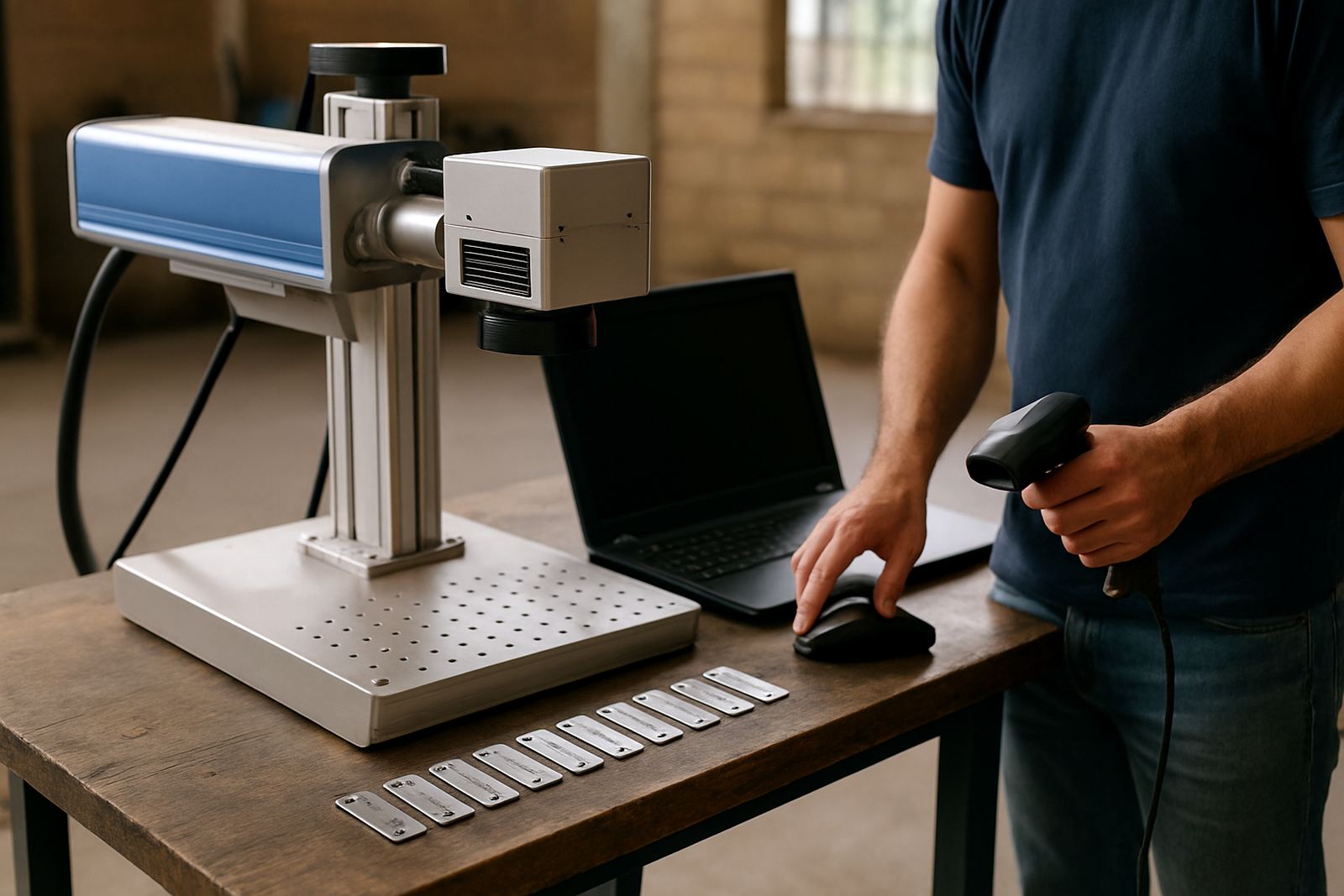
Serial numbering means each part gets a unique number in sequence, such as 0001, 0002, 0003, or a code that includes a date, batch or order reference. In a fibre laser machine, that sequence is controlled in the marking file or linked to the production job, so the operator does not type every number by hand.
For metal components and jewellery, this matters because the mark must stay legible after handling, cleaning, plating, polishing or heat exposure. A serial number is not only for records. It helps with traceability, warranty work, quality checks and customer queries when a part comes back months later.
In Wadeville and the wider Germiston area, many job shops work with short runs and repeat orders. Serial numbering helps when the same part is produced in different batches, because each run can be separated by range, for example SN1021 to SN1100 for one order and SN1101 to SN1180 for the next.
How Sequential Numbering Is Set Up in Fibre Laser Software
Most fibre laser marking software lets you insert a serial field into the design. The operator sets the start number, the step value and the format. A simple job might start at 1000 and increase by 1. A more detailed job can add leading zeros, letters or fixed text. For example, GY-000245 or JP24-0187.
The important part is consistency. If the file is saved with the wrong start point, the whole batch can be out. That is why many teams use a standard setup sheet for each customer or product line. It records the font, marking depth, focal height, serial range and any special notes on the fixture.
- Set the first number before the batch starts
- Confirm the increment, usually 1 but sometimes 5 or 10
- Decide whether zeros must stay in front
- Check if text and serial numbers should sit on one line or two
- Save the approved file name so operators use the same format every time
In practice, this cuts down on manual correction and keeps the job moving, even when more than one operator handles the same machine.
The Difference Between Counter Use and Production Job Control
Some users think serial numbering is only a simple counter, but production work often needs more control. A counter is fine for short runs. For repeat contracts, you may need number resets, batch codes and job locking so the wrong sequence does not carry over into the next order.
That becomes important in a workshop that runs several parts on the same shift. One fixture may be for stainless tags, another for anodised aluminium plates and another for small brass jewellery components. If the operator loads the wrong file or forgets to reset the counter, the batch can be spoiled.
- Use a separate saved file for each product family
- Reset the serial count only when the production sheet says so
- Keep one person responsible for approving start numbers
- Record any skipped numbers and the reason for them
- Test the first 2 or 3 marks before releasing the full batch
Good control is not complicated. It is mostly about discipline and simple checks before the first part is marked.
Mark Quality on Metal Parts and Jewellery
Not every surface behaves the same way. A fibre laser can mark stainless steel, mild steel, aluminium, brass and many coated metals, but the serial must still be readable after handling. On small jewellery items, the available space may be only a few millimetres wide, so the font size and line spacing must be chosen carefully.
For industrial parts, a deeper or higher contrast mark may be needed. For jewellery, the mark may need to stay discreet but clean. A serial number that is too small can disappear after polishing, while one that is too large can affect the look of the item. That is why sample marking before full production saves time and scrap.
Coastal humidity, dust and workshop vibration can also affect results over time if the machine is not checked properly. On some sites the issue is not the laser at all, but a loose fixture or a part that shifts during marking. The number may look fine on screen but land off-centre on the workpiece.
Batch Records, Compliance and Traceability
Serial numbering is useful far beyond the marking bay. It gives the production team a way to link each item to a batch, an operator, a material lot or a customer order. That is helpful when a client asks which units went out on a specific date, or when a site audit needs proof that every item was marked correctly.
For businesses supplying municipal work, contract fabrication or export parts, traceability can be the difference between finding the right record straight away and a long search through job cards. Keep the numbering system simple enough that the team can follow it under pressure. If the code is too clever, it will be misread.
A practical record sheet should note the serial range used, the machine settings, the fixture used and any rejected parts. It does not need to be fancy. It just needs to be clear and easy to check later.
A Germiston Example from Short-Run Production
A small Wadeville workshop making engraved stainless tags for a Gauteng equipment supplier may run 150 parts in the morning and 80 more after lunch. The tags need a unique serial number for each unit, plus a customer code. If the operator starts at 5001 and forgets to save the file after a power interruption during load-shedding, the batch can restart at the wrong number and the records no longer match.
The better approach is to keep the file saved with the correct start point, confirm the first mark on a test tag and note the last number used before the job stops. If the site uses battery backup or a controlled shutdown routine, the restart is simpler. If not, the operator should confirm the next number with the production sheet before continuing.
That kind of routine saves hours later. It also reduces arguments over missing numbers, duplicate marks and rework.
- Save the job after any approved number change
- Write down the last completed serial before stopping
- Check the next serial against the batch card
- Use sample parts after a restart, not the live batch
When to Ask for Setup Help or Calibration
If serial numbers are coming out faint, drifting off position or changing unexpectedly, the issue may be software setup, focus, fixture design or the marking surface itself. Some jobs need focus calibration, especially where parts vary in thickness or where multiple fixtures are used on one machine.
Training helps too. New operators often know how to open a file but not how to handle resets, counters or sample approval. A proper handover should cover file naming, number ranges, the meaning of each field and how to recover after a stoppage. That is much safer than relying on memory.
For businesses in Germiston, Jet Park, Isando, Kempton Park, Boksburg and Alberton, as well as sites further afield, serial numbering works best when the machine, software and process all match the job. Once that is in place, numbering becomes one of the simplest parts of production rather than the one that causes the most rework.